Showing posts with label tomatoes. Show all posts
Thursday, October 1, 2015
Agriculture 2015 -- epic fail
We had four or five tomato plants this summer, not that you would have noticed. Between the deer, the groundhogs, the squirrels and god knows what else, maybe orangutans, we got nothing from our plants until a week ago. A couple of tomatoes got to be fair-sized in August and even started to turn color, but were grabbed by the critters before we could pick them. I don't think any of them ever got to be red.
Finally in mid-September the Roma started to have some fruit, and a week ago Ken decided he'd had it -- he picked what was on the plants, pulled them out and threw them out for the yard waste pickeup.
Here is 100% of our tomato crop for 2015, not occupying very much space on the kitchen table.
In the subsequent week, the green tomatoes turned red, one of the red ones went bad, and I decided it was high time to cook them up and be done with them.
Here's half of our tomato crop for 2015; the other half was on Ken's plate. Puny and pathetic as they looked on the kitchen table, they did caramelize nicely and made a rich side for a particularly delicious trout.
Hardly worth the trouble, wouldn't you say? We've had bad tomato years in the past but nothing like this. Next year we'll probably not even try. An ignominious end to a decades-long tomato-growing career.
Friday, September 6, 2013
Vegetable blues
This has been the worst summer for fruits and vegetables in my memory. Our zucchetta has produced four fruits, one of which ripened while we were gone on vacation and became an almost-inedible baseball bat. Another was soft at the flower end and I had to cut off a third of it.
Here's approximately 50% of our entire tomato crop for the year. They tasted great.
Not just our own crops have been disappointing, but also those from the market. The watermelons have had seeds, true, but only one or two have tasted really wonderful. The tomatoes have been insipid, even the beautiful red ones from the farmer's market. I've ended up roasting or pan-caramelizing more than we've eaten raw. No juicy tomato sandwiches; no wonderful fresh-tomato pasta sauces. Even the heirloom tomato salad at the pricy new restaurant was on the so-so side.
(that's crabmeat and bacon on top, lemon aioli on the plate; magnificent even with so-so tomatoes)
We've had some disappointing peaches on and off all summer, so much that I'm afraid to buy more than two or three at a time. Last week we bought three. The first one was magnificent -- the best I'd eaten all summer. The second and the third were mediocre.
On the bright side, the corn has been superb all year. I think they must have made some permanent breeding improvements in the last five years, because no matter where it comes from, the corn seems to be consistently excellent throughout the season. Thank heaven something is turning out reliably delicious.
Here's approximately 50% of our entire tomato crop for the year. They tasted great.
Not just our own crops have been disappointing, but also those from the market. The watermelons have had seeds, true, but only one or two have tasted really wonderful. The tomatoes have been insipid, even the beautiful red ones from the farmer's market. I've ended up roasting or pan-caramelizing more than we've eaten raw. No juicy tomato sandwiches; no wonderful fresh-tomato pasta sauces. Even the heirloom tomato salad at the pricy new restaurant was on the so-so side.
(that's crabmeat and bacon on top, lemon aioli on the plate; magnificent even with so-so tomatoes)
We've had some disappointing peaches on and off all summer, so much that I'm afraid to buy more than two or three at a time. Last week we bought three. The first one was magnificent -- the best I'd eaten all summer. The second and the third were mediocre.
On the bright side, the corn has been superb all year. I think they must have made some permanent breeding improvements in the last five years, because no matter where it comes from, the corn seems to be consistently excellent throughout the season. Thank heaven something is turning out reliably delicious.
Monday, September 2, 2013
Desperation defense
It has been a perfectly terrible year for our home garden, and we've heard the same from others. Critters have practically destroyed our tomatoes (we've had two or three all year, and only one was really good). Our zucchetta, previously so prolific that in August I used to never leave the house without a plastic bag full of squash to foist upon friends, neighbors and homeless people encountered in the street, has given us about three fruits all year. Even our basil has been hit by a blight, and the big batch of pesto I processed a couple of weeks ago will be it.
In the midst of lamenting our bad luck, we commented the other night that it's a good thing we're not dependent upon our crops to get us through the winter, because we'd starve before Thanksgiving.
We tried to protect the tomatoes from the critters (deer, chipmunks, squirrels, groundhogs, raccoons, all have been seen on our property and we don't know what all is feasting on our stuff) but to no avail. We encased a ripening tomato in a plastic onion bag and the critter ate through the plastic to get a nice bite of tomato. We've pretty much given up on everything and are about to just rip the plants out and put the whole garden into arugula for fall (our critters hate arugula).
On my walk the other day I encountered a gardener who apparently shares our frustration, but unlike us, isn't ready to give up yet. Here's how he's protecting his tomatoes.
I say, good luck.
In the midst of lamenting our bad luck, we commented the other night that it's a good thing we're not dependent upon our crops to get us through the winter, because we'd starve before Thanksgiving.
We tried to protect the tomatoes from the critters (deer, chipmunks, squirrels, groundhogs, raccoons, all have been seen on our property and we don't know what all is feasting on our stuff) but to no avail. We encased a ripening tomato in a plastic onion bag and the critter ate through the plastic to get a nice bite of tomato. We've pretty much given up on everything and are about to just rip the plants out and put the whole garden into arugula for fall (our critters hate arugula).
On my walk the other day I encountered a gardener who apparently shares our frustration, but unlike us, isn't ready to give up yet. Here's how he's protecting his tomatoes.
I say, good luck.
Friday, March 15, 2013
Seafood pasta
I invented "seafood pasta" many years ago when my husband and I were both working and we required our middle-school boys to each cook dinner once a week. I prepared a cookbook for their guidance, including info such as which pan to use and how soon before dinner to start working. Seafood pasta had the advantage of being prepared solely from cans and boxes (plus an onion) and not taking very long.
My standard seafood pasta recipe called for a can of tuna, a can of clams (or a second can of tuna), an onion, a can or two of diced tomatoes, depending on how many people were eating, and some pasta. You can probably figure out how to put those ingredients together, and it doesn't really matter what order you do them in.
As we have become a bit more culinarily adventurous in our old age, the seafood pasta recipe has evolved. The other night I found myself about as close to ground zero as a cook can be -- practically nothing in the fridge. We didn't really want to go to the store so I searched around in the cupboard and came up with seafood pasta. But this was a more exotic version than in the Mom Cookbook.
I did have an onion, so I cut it up and sauteed it in a big pan. Meanwhile I got to opening cans: a can of artichoke hearts, a can of tuna, a tiny can of anchovies. I had garlic in the fridge, so I cut that up too. And best of all, I had a few leftover tomatoes that I had roasted in the oven for a couple of hours several days ago.
To the slow-cooked onions I added the artichoke hearts, allowing them to brown a bit in olive oil over fairly high heat. Then the anchovies in their oil, stirring and poking with a wooden spoon until they dissolved into a dark, salty ooze. The chopped garlic went in toward the end of that process, just before I added a third-bottle of wine left over from our reception at the art gallery the night before, and the pasta.
While the pasta cooked in the flavorful sauce, I added the leftover tomatoes and a bit of boiling water toward the end to make sure it didn't end up too dry. I love this one-pot pasta method; much easier than making the sauce and the pasta separately, also more energy-efficient and resulting in fewer dirty dishes.
Years ago I would have used one or two anchovy fillets, and even today felt a bit reckless using the whole can. But that turned out to be the secret ingredient: it gave a salty, sophisticated gourmet edge to the pasta.
We never use grated cheese when our pasta contains seafood, so we needed the oomph to come from the anchovies and garlic. And they delivered plenty of that! I'll remember this combination and do it again.
My standard seafood pasta recipe called for a can of tuna, a can of clams (or a second can of tuna), an onion, a can or two of diced tomatoes, depending on how many people were eating, and some pasta. You can probably figure out how to put those ingredients together, and it doesn't really matter what order you do them in.
As we have become a bit more culinarily adventurous in our old age, the seafood pasta recipe has evolved. The other night I found myself about as close to ground zero as a cook can be -- practically nothing in the fridge. We didn't really want to go to the store so I searched around in the cupboard and came up with seafood pasta. But this was a more exotic version than in the Mom Cookbook.
I did have an onion, so I cut it up and sauteed it in a big pan. Meanwhile I got to opening cans: a can of artichoke hearts, a can of tuna, a tiny can of anchovies. I had garlic in the fridge, so I cut that up too. And best of all, I had a few leftover tomatoes that I had roasted in the oven for a couple of hours several days ago.
To the slow-cooked onions I added the artichoke hearts, allowing them to brown a bit in olive oil over fairly high heat. Then the anchovies in their oil, stirring and poking with a wooden spoon until they dissolved into a dark, salty ooze. The chopped garlic went in toward the end of that process, just before I added a third-bottle of wine left over from our reception at the art gallery the night before, and the pasta.
While the pasta cooked in the flavorful sauce, I added the leftover tomatoes and a bit of boiling water toward the end to make sure it didn't end up too dry. I love this one-pot pasta method; much easier than making the sauce and the pasta separately, also more energy-efficient and resulting in fewer dirty dishes.
Years ago I would have used one or two anchovy fillets, and even today felt a bit reckless using the whole can. But that turned out to be the secret ingredient: it gave a salty, sophisticated gourmet edge to the pasta.
We never use grated cheese when our pasta contains seafood, so we needed the oomph to come from the anchovies and garlic. And they delivered plenty of that! I'll remember this combination and do it again.
Friday, September 21, 2012
Dinner from the past
As frequently happens in the afternoon, I asked my husband if he had any brilliant ideas for dinner. Was there anything in particular that he would love?
And to my surprise, he suggested -- eatmore!
Eatmore was one of his mother's regular dinners, consisting of ground beef, tomatoes, noodles, and other ingredients that hadn't lasted quite so strongly in memory. We'd discussed this dish in the past, and I had recalled one of my mother's regular dinners, known as "goulash" but bearing no resemblance to any goulash you would find in Hungary or any cookbook. Indeed, our "goulash" was very similar to his eatmore -- ground beef, tomatoes, elbow macaroni.
Both eatmore and "goulash" were swimming in a lot of tomato broth. My mother-in-law would often siphon off the broth and serve it as a separate soup course, thus enabling the main course to be served on a plate. By contrast, my mother's goulash was served in bowls (I think I'm remembering right) and you slurped up the broth with a spoon.
I used to hate goulash night. Not that it tasted bad, but I didn't like that juice. It made the whole entree seem insipid and washed out. On goulash night I would volunteer to serve out the plates, giving my own plate as little of the juice as possible.
My husband, on the other hand, thought the broth was wonderful.
When he expressed the surprising desire for eatmore it was even more surprising that I said why not -- the first time in 42 years of marriage that I had done so. I asked whether eatmore ever included bell peppers (we owned two big red peppers that were perilously near the end of their shelf life) and he said he thought it did. Since this was a nostalgia trip, I asked whether it included onions (he thought yes) and asked him to find the closest possible noodle from our pasta shelf.
I found a pack of already cooked ground beef in the freezer, which made life much easier. Cut up the peppers and an onion, added a fresh tomato that was also in dire need of being eaten plus a can of diced tomatoes. Set it all to cooking.
Next question: what seasonings were used in eatmore? He searched his memory and thought none. Which is exactly what seasonings were used in "goulash." But that sounded inadequate, so I took the liberty of adding some garlic and some marsala wine to wash out the tomato can.
I'm sure both our mothers would have cooked the pasta in a separate pot, but I almost always cook pasta in with its sauce. Fewer pans to wash, and the pasta absorbs good flavor instead of just serving as a neutral base.
Old habits die hard. I served up my husband's bowl with lots of juice, but kept mine as dry as possible. He loved his. I thought mine was insipid and washed out. Maybe it was the peppers -- plenty of them, and so sweet that they dominated the dish. (Probably my mother-in-law would have used green peppers; maybe they would have tasted better.) Maybe it was the memory of "goulash" hanging over my head.
But at least one of us was really happy!
Friday, September 7, 2012
Tomato bust
I wrote last week about a tomato bonanza. That was great, but it was thanks to the farmers market, not to our own gardening prowess. This week I will focus on the flip side, our homegrown tomato bust.
I brought it on myself, by boasting in June about our early tomato crop (two cherry tomatoes). The gods listened and punished. Although we had decent weather and no drought, and the plants looked fairly healthy, we never got any fruit from that point on. A few times, big green tomatoes fell prey to some kind of critters -- here today, on the ground with bites taken out tomorrow. Then as summer wore on, even the green tomatoes stopped coming.
We got a few cherry tomatoes now and then, but not a single big one from two plants. Finally the last week of August we noticed one nice green tomato. We desperately wanted to keep it for ourselves, so we wrapped it in a mesh vegetable bag and waited for it to ripen. Finally we would outsmart the critters.
Several days later I stopped by the vegetable patch to check on the tomato. Sure enough, it was turning red -- but it was no longer attached to the vine!

Had a critter jumped on it with enough oomph to detach it? Are people actually smarter than rodents?
We brought the tomato in and let it ripen on the counter. A week later it was ready.
Absolutely delicious -- summer distilled into a single bite. Our entire year's crop on a single small plate.
I brought it on myself, by boasting in June about our early tomato crop (two cherry tomatoes). The gods listened and punished. Although we had decent weather and no drought, and the plants looked fairly healthy, we never got any fruit from that point on. A few times, big green tomatoes fell prey to some kind of critters -- here today, on the ground with bites taken out tomorrow. Then as summer wore on, even the green tomatoes stopped coming.
We got a few cherry tomatoes now and then, but not a single big one from two plants. Finally the last week of August we noticed one nice green tomato. We desperately wanted to keep it for ourselves, so we wrapped it in a mesh vegetable bag and waited for it to ripen. Finally we would outsmart the critters.
Several days later I stopped by the vegetable patch to check on the tomato. Sure enough, it was turning red -- but it was no longer attached to the vine!
Had a critter jumped on it with enough oomph to detach it? Are people actually smarter than rodents?
We brought the tomato in and let it ripen on the counter. A week later it was ready.
Absolutely delicious -- summer distilled into a single bite. Our entire year's crop on a single small plate.
Saturday, September 1, 2012
Tomato bonanza
Today we have a tomato bonanza. Not because of our garden -- I'll give you an update on that sorry situation in a later post. Instead we went to the farmer's market.
Our favorite farmer always has two tables of tomatoes. On the big front table are perfect tomatoes of several different varieties, at $2.50 a pound. On the back table are seconds, at $1.20. I always like to buy the cheap seconds, figuring we'll eat them quickly and what's the difference. My husband always likes to buy at full price, since he has noted how we often have to cut out a bad spot from the seconds.
I note that we never lose half of the tomato, so we're ahead on price even if some spots go bad. He notes that it won't kill us to spend another dollar or two. We have not resolved this issue and I don't suppose we ever will.
Today he announced that he was going to buy full price. I announced that I was going to buy seconds and roast them in the oven the minute we got home. So we each did. Then on the way back to the car we saw two huge heirloom tomatoes on the sidewalk, apparently escaped from some other shopper's bag. I picked them up, inspected them and found only the damage you would expect when a perfect tomato hits the ground.
So we found ourselves with this haul -- full price on the left, seconds in the middle, and sidewalk finds at the right.
Plus another find: when I was taking some stuff out of the back of my car I found a tomato on the floor, under the front seat. Can't remember when it got there. It had started to go bad on one side, but not to the point of ruining my carpet, so I cut out the bad part and put the good half into my roasting pan.
The rosemary is about our only successful crop this year, and I put some big sprigs into the bottom of the pan. Poured olive oil generously over the cut-up seconds, and roasted them at about 300 degrees for a couple of hours. There was room in the pan so I threw in an eggplant too.
I love the way tomatoes roast down and caramelize in a slow oven. You do want to take out the juice every now and then, so they can roast rather than stew, but save it, because it has reduced and sweetened as well. Finally I deglazed the pan with a bit of marsala wine and added that to the juice.
Here's my bounty: the tomatoes cooked down dramatically, but are enough for a magnificent pasta meal sometime next week. And plenty of perfect tomatoes to eat raw in the meantime.
Our favorite farmer always has two tables of tomatoes. On the big front table are perfect tomatoes of several different varieties, at $2.50 a pound. On the back table are seconds, at $1.20. I always like to buy the cheap seconds, figuring we'll eat them quickly and what's the difference. My husband always likes to buy at full price, since he has noted how we often have to cut out a bad spot from the seconds.
I note that we never lose half of the tomato, so we're ahead on price even if some spots go bad. He notes that it won't kill us to spend another dollar or two. We have not resolved this issue and I don't suppose we ever will.
Today he announced that he was going to buy full price. I announced that I was going to buy seconds and roast them in the oven the minute we got home. So we each did. Then on the way back to the car we saw two huge heirloom tomatoes on the sidewalk, apparently escaped from some other shopper's bag. I picked them up, inspected them and found only the damage you would expect when a perfect tomato hits the ground.
So we found ourselves with this haul -- full price on the left, seconds in the middle, and sidewalk finds at the right.
Plus another find: when I was taking some stuff out of the back of my car I found a tomato on the floor, under the front seat. Can't remember when it got there. It had started to go bad on one side, but not to the point of ruining my carpet, so I cut out the bad part and put the good half into my roasting pan.
The rosemary is about our only successful crop this year, and I put some big sprigs into the bottom of the pan. Poured olive oil generously over the cut-up seconds, and roasted them at about 300 degrees for a couple of hours. There was room in the pan so I threw in an eggplant too.
I love the way tomatoes roast down and caramelize in a slow oven. You do want to take out the juice every now and then, so they can roast rather than stew, but save it, because it has reduced and sweetened as well. Finally I deglazed the pan with a bit of marsala wine and added that to the juice.
Here's my bounty: the tomatoes cooked down dramatically, but are enough for a magnificent pasta meal sometime next week. And plenty of perfect tomatoes to eat raw in the meantime.
Tuesday, June 19, 2012
The first tomatoes
In Louisville, the locals traditionally observe the Kentucky Derby, the first Saturday in May, by planting their tomatoes, then coming in to have a drink and watch the race on TV. At least that's how we've done it for a long time. As a result, we generally get our first harvest on or about the Fourth of July, although one year it wasn't until my husband's birthday, July 27.
But this year, with no winter to speak of, and a spell of unseasonably warm weather in February and March, the ground warmed up early and the tomatoes went in the ground in mid-April. And today we had the first harvest, by far the earliest in Loomis family farm history!
We held a ceremonial eating and found them to be a little on the underdone side -- another day on the vine would have been much better -- but they were definitely homegrown, not hothouse, and at least it was us doing the eating and not the critters.
Last year we had terrible luck with the tomatoes, mainly because they didn't grow worth a damn, but also because those few that did survive got eaten by squirrels or chipmunks or birds or something. There is nothing so demoralizing to a gardener than to see a decent-sized vegetable lying on the driveway with one or two bites out of it, like this one from last summer.
The critters don't even seem to want the food, they just want to make sure we don't get it. This year my husband was determined that we got the first tomatoes, so as soon as these turned red he brought them in.
I hope this means we'll have bumper crops of everything this year. We ate the first zucchetta last week, and the big tomatoes, which always take longer than the little ones, are getting fat on the vine. We're keeping our fingers crossed for lots of good eats this summer.
But this year, with no winter to speak of, and a spell of unseasonably warm weather in February and March, the ground warmed up early and the tomatoes went in the ground in mid-April. And today we had the first harvest, by far the earliest in Loomis family farm history!
We held a ceremonial eating and found them to be a little on the underdone side -- another day on the vine would have been much better -- but they were definitely homegrown, not hothouse, and at least it was us doing the eating and not the critters.
Last year we had terrible luck with the tomatoes, mainly because they didn't grow worth a damn, but also because those few that did survive got eaten by squirrels or chipmunks or birds or something. There is nothing so demoralizing to a gardener than to see a decent-sized vegetable lying on the driveway with one or two bites out of it, like this one from last summer.
The critters don't even seem to want the food, they just want to make sure we don't get it. This year my husband was determined that we got the first tomatoes, so as soon as these turned red he brought them in.
I hope this means we'll have bumper crops of everything this year. We ate the first zucchetta last week, and the big tomatoes, which always take longer than the little ones, are getting fat on the vine. We're keeping our fingers crossed for lots of good eats this summer.
Tuesday, August 23, 2011
A glimmer of hope from the garden
We've been having a lousy year in the garden -- still only a couple of tomatoes and zucchetta instead of the huge bounty that you're supposed to have in August. A week ago we scored big -- my friend K got sick of me whining about my tomatoes and brought me a huge haul of goodies from her garden (and even a bit from her neighbor's garden).
That got us through the week very happily, but now we're back to whining.
But we did have one good harvest: enough basil for a big batch of pesto. I wrote last fall about how I process basil and freeze it. It was nice to get a good pesto/pasta meal out of the garden, plus extra to put away for later.
That got us through the week very happily, but now we're back to whining.
But we did have one good harvest: enough basil for a big batch of pesto. I wrote last fall about how I process basil and freeze it. It was nice to get a good pesto/pasta meal out of the garden, plus extra to put away for later.
Sunday, August 7, 2011
Totally tomatoless
I don't know what's going on with tomatoes but we're having a mysterious impasse. Our plants have been full of green tomatoes for weeks, but they never turn red. We had some Sun Sugar baby tomatoes early last month, but nothing since then. Meanwhile our big tomatoes sit there, green as grass.
We've had plenty of heat and sunshine, which I thought were necessary for tomatoes (maybe we've had too much?). We've had plenty of rain, which we don't always get in July. The plants have set fruit (often a problem in extreme heat) and the fruit has gotten big and beautiful. But not red.
A few of the tomatoes ended up like this one, half-eaten on the driveway, ravaged by squirrels or chipmunks or some other kind of varmint. If they'd just eat the whole thing I'd be less resentful, but no, they only eat a bite or two and leave the rest there to taunt us.
But most of our tomatoes are sitting there waiting for some kind of signal from the universe, and I've heard similar stories from other people. Meanwhile my friend K is drowning in gorgeous red tomatoes and I'm jealous. If not for the farmers' market we would be totally tomatoless.
I've usually thought of green tomatoes as a fall dish, when the vines are full but you know you'd better eat them before the killing frost. Eating green tomatoes in July always seemed like shooting yourself in the foot -- it only postponed the moment when you got to eat the first wonderful red ones. But I may have to change my plan this year. If we don't eat them green, who knows when or if we'll be able to eat them at all!
We've had plenty of heat and sunshine, which I thought were necessary for tomatoes (maybe we've had too much?). We've had plenty of rain, which we don't always get in July. The plants have set fruit (often a problem in extreme heat) and the fruit has gotten big and beautiful. But not red.
A few of the tomatoes ended up like this one, half-eaten on the driveway, ravaged by squirrels or chipmunks or some other kind of varmint. If they'd just eat the whole thing I'd be less resentful, but no, they only eat a bite or two and leave the rest there to taunt us.
But most of our tomatoes are sitting there waiting for some kind of signal from the universe, and I've heard similar stories from other people. Meanwhile my friend K is drowning in gorgeous red tomatoes and I'm jealous. If not for the farmers' market we would be totally tomatoless.
I've usually thought of green tomatoes as a fall dish, when the vines are full but you know you'd better eat them before the killing frost. Eating green tomatoes in July always seemed like shooting yourself in the foot -- it only postponed the moment when you got to eat the first wonderful red ones. But I may have to change my plan this year. If we don't eat them green, who knows when or if we'll be able to eat them at all!
Wednesday, July 13, 2011
Tiny tomatoes
We always write down on our calendar the date of the first tomato from our garden. In the past, we've generally anticipated that tomatoes will be edible toward the end of July. Once we had a tomato on the Fourth, but that was a one-time phenomenon -- until this year.
Thanks to hot weather and plenty of rain throughout the springtime, my resident farmer got the tomato plants into the ground earlier than usual, and we actually had a couple of tiny tomatoes on July 1.
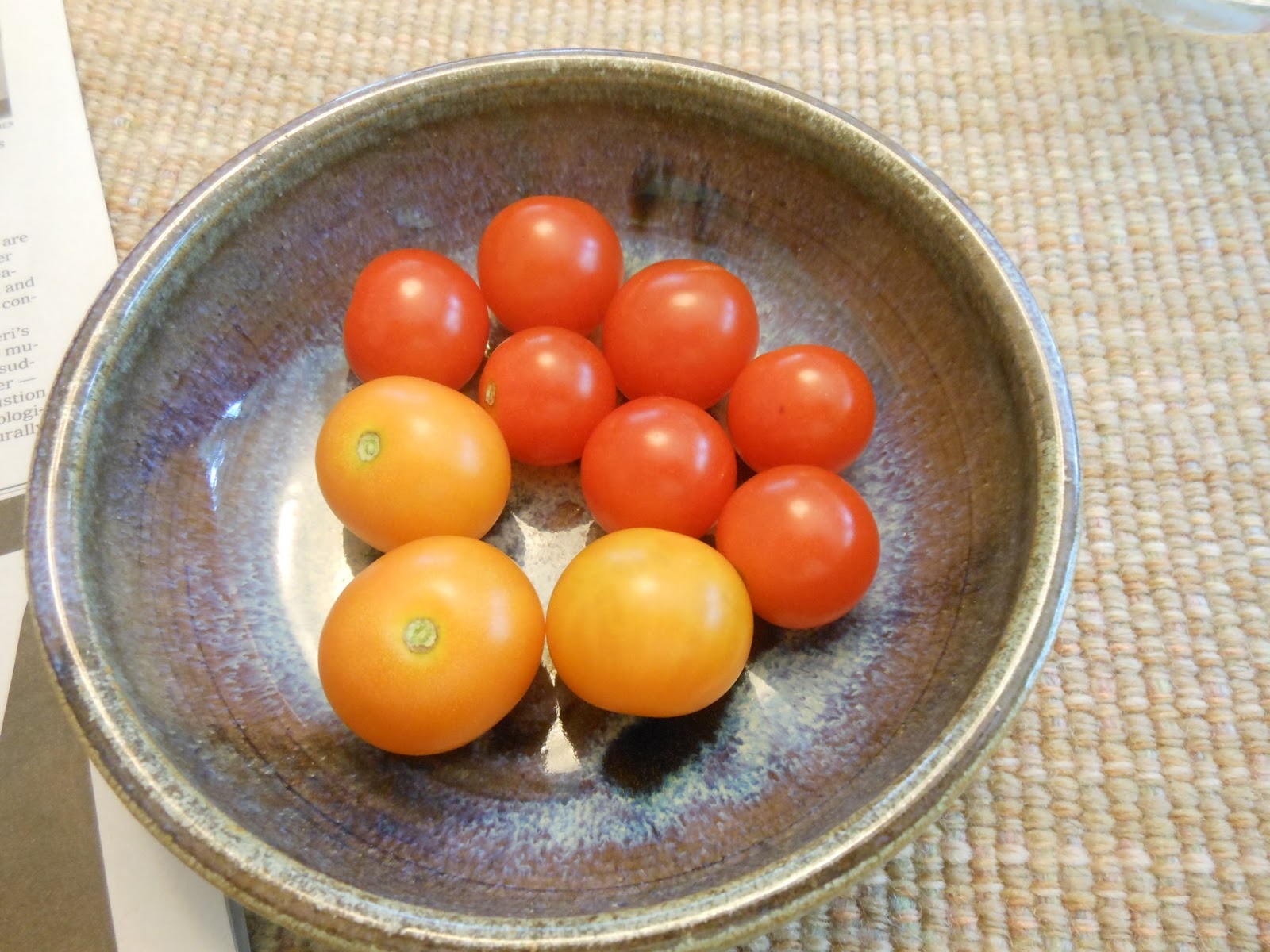
Now they're coming in more prolifically, so that you can eat a half-dozen or more out of the snack bowl on the dining room table. This variety is Sun Sugar, which we've been growing and loving for several years.
We're still at least a week away from any big tomatoes, although we have lots of green ones on our plants. Meanwhile, we've had some nice local tomatoes from the farmer's market, but there's nothing so delicious as one from your own garden, still warm from the sun. I'll let you know when that happens!
Thanks to hot weather and plenty of rain throughout the springtime, my resident farmer got the tomato plants into the ground earlier than usual, and we actually had a couple of tiny tomatoes on July 1.
Now they're coming in more prolifically, so that you can eat a half-dozen or more out of the snack bowl on the dining room table. This variety is Sun Sugar, which we've been growing and loving for several years.
We're still at least a week away from any big tomatoes, although we have lots of green ones on our plants. Meanwhile, we've had some nice local tomatoes from the farmer's market, but there's nothing so delicious as one from your own garden, still warm from the sun. I'll let you know when that happens!
Monday, February 14, 2011
Diet fried green tomatoes
So who doesn't like fried green tomatoes the classic southern way, with a nice breaded crust that obviously came out ot a pan full of melted lard in the back room? Except that I don't want to cook them in my back room. Too much grease to deal with, and of course the caloric load is on the high side.
(I will digress. I am perfectly willing to eat the occasional high-calorie treat, especially when the underlying food is a vegetable. Broccoli with hollandaise, cauliflower with cheese sauce, fried zucchini, vegetable tempura, eggplant parmesan, all are wonderful, but you don't want to eat them that way every night unless you're a recovering anorexic.)
I have tried to fix green tomatoes with various kinds of breading and battering, and they all entailed a lot of work, a messy kitchen and coatings that often slipped off the tomatoes. That's three strikes: a fattening food that is a pain to fix and doesn't even turn out perfect.
Here's my alternative. Fry the tomatoes in bacon grease, over high heat at first to get them nice and brown, then over lower heat to make them tender. You can't possibly get this wrong, because the tomatoes taste great whether you cook them almost to mush or leave them almost crisp.
Then if you want a fancy finish, deglaze the pan with a little Marsala wine and cook it down a minute into a sauce. It's nice if there's enough sauce to also go on the fish or whatever else is on your plate. I suspect you'll never have the urge to fix green tomatoes with a breading again.
(I will digress. I am perfectly willing to eat the occasional high-calorie treat, especially when the underlying food is a vegetable. Broccoli with hollandaise, cauliflower with cheese sauce, fried zucchini, vegetable tempura, eggplant parmesan, all are wonderful, but you don't want to eat them that way every night unless you're a recovering anorexic.)
I have tried to fix green tomatoes with various kinds of breading and battering, and they all entailed a lot of work, a messy kitchen and coatings that often slipped off the tomatoes. That's three strikes: a fattening food that is a pain to fix and doesn't even turn out perfect.
Here's my alternative. Fry the tomatoes in bacon grease, over high heat at first to get them nice and brown, then over lower heat to make them tender. You can't possibly get this wrong, because the tomatoes taste great whether you cook them almost to mush or leave them almost crisp.
Then if you want a fancy finish, deglaze the pan with a little Marsala wine and cook it down a minute into a sauce. It's nice if there's enough sauce to also go on the fish or whatever else is on your plate. I suspect you'll never have the urge to fix green tomatoes with a breading again.
Friday, November 12, 2010
Caramelize your troubles away
So what do you do when your fresh tomato tastes more like styrofoam than tomato? Or when your apple has a mushy texture? Or when your red pepper is bland and insipid?
Sometimes you know from the start that the produce is going to be underwhelming, such as when you buy supermarket tomatoes in winter. Often the sinking feeling comes when it's too late to do much about the situation -- you've already sliced the pepper, or bit into the apple. But you aren't so disappointed as to throw the food away.
This is the moment for the frying pan! Whatever meager, pathetic juices and flavor that vegetable or fruit may have can be maximized by heat and some oil or butter. After everything caramelizes, you'll have a concoction far more delicious than you ever dreamed could emanate from such a sorry beginning.
For tomatoes, slice or quarter them and put them into a hot skillet with olive oil, then cook on high heat a couple of minutes longer than you think is wise. (Put a spatter guard over the skillet to keep the stove clean.) The tomatoes will get really brown, and maybe even borderline charred, but that's OK. Turn them and do the same to the other side.
If the tomatoes give off so much juice that they're starting to stew rather than saute, pour it off into a cup and set it aside. Finally, all the edges have been nicely browned and the tomato has gotten very soft. At this point deglaze the pan with a little marsala wine or sherry and turn the heat down while the wine reduces to a rich reddish-brown sauce.
The tomatoes can be served as a side dish, or stashed in the fridge for a future pasta, risotto or soup. If there's extra juice in the cup on the side, it can be added back or saved to be a cooking liquid.
I like this cooking method so much that I'll buy tomatoes from the supermarket all year, knowing they won't be fit to eat raw, but knowing that they'll cook down to a delicious ingredient. It's also possible to cook a large quantity of tomatoes with olive oil in a pan in a hot oven, for instance if you are the lucky recipient of a windfall from the garden.
For peppers, either red or green, saute them in olive oil over high heat until they're browned on all sides, maybe even hitting the borderline of charred. If the pieces are large, use the spatula to push the curved parts down flat against the pan. I like my cooked peppers limp, so I'll turn the heat down and let them keep cooking on the back burner for a while, but you might like to take yours off the heat while they're still on the crispy side.
You can also cook peppers under the broiler (you don't need to use oil this way, although they're delicious served with a bit of olive oil drizzled on top) or if you have a gas stove, you can toast them over the flame like a marshmallow (never having had a gas stove, I cannot testify to this method but I have read about it many times). With either method, cook until the skin chars (if it chars too much, you can peel it off).
Cooked peppers can be served as a side dish or saved to go into a sandwich or onto a pizza. I usually think they're too assertive to make good soup vegetables, but love them in pastas and risotto.
For apples or pears, saute them in a skillet with butter, getting all sides brown (but not brown/burned as with tomatoes and peppers). You can eat them at this point, or turn the heat down, cover the pan, and let them cook a while, maybe add a bit of orange juice, water, or wine if you want a fancy dessert. A little nutmeg, cinnamon or ginger on top makes it special.
Of course, you can always turn disappointing apples into applesauce, but this is a nice alternative and works nicely when you have only one or two pieces of dud fruit instead of a bagful.
Sometimes you know from the start that the produce is going to be underwhelming, such as when you buy supermarket tomatoes in winter. Often the sinking feeling comes when it's too late to do much about the situation -- you've already sliced the pepper, or bit into the apple. But you aren't so disappointed as to throw the food away.
This is the moment for the frying pan! Whatever meager, pathetic juices and flavor that vegetable or fruit may have can be maximized by heat and some oil or butter. After everything caramelizes, you'll have a concoction far more delicious than you ever dreamed could emanate from such a sorry beginning.
For tomatoes, slice or quarter them and put them into a hot skillet with olive oil, then cook on high heat a couple of minutes longer than you think is wise. (Put a spatter guard over the skillet to keep the stove clean.) The tomatoes will get really brown, and maybe even borderline charred, but that's OK. Turn them and do the same to the other side.
If the tomatoes give off so much juice that they're starting to stew rather than saute, pour it off into a cup and set it aside. Finally, all the edges have been nicely browned and the tomato has gotten very soft. At this point deglaze the pan with a little marsala wine or sherry and turn the heat down while the wine reduces to a rich reddish-brown sauce.
The tomatoes can be served as a side dish, or stashed in the fridge for a future pasta, risotto or soup. If there's extra juice in the cup on the side, it can be added back or saved to be a cooking liquid.
I like this cooking method so much that I'll buy tomatoes from the supermarket all year, knowing they won't be fit to eat raw, but knowing that they'll cook down to a delicious ingredient. It's also possible to cook a large quantity of tomatoes with olive oil in a pan in a hot oven, for instance if you are the lucky recipient of a windfall from the garden.
For peppers, either red or green, saute them in olive oil over high heat until they're browned on all sides, maybe even hitting the borderline of charred. If the pieces are large, use the spatula to push the curved parts down flat against the pan. I like my cooked peppers limp, so I'll turn the heat down and let them keep cooking on the back burner for a while, but you might like to take yours off the heat while they're still on the crispy side.
You can also cook peppers under the broiler (you don't need to use oil this way, although they're delicious served with a bit of olive oil drizzled on top) or if you have a gas stove, you can toast them over the flame like a marshmallow (never having had a gas stove, I cannot testify to this method but I have read about it many times). With either method, cook until the skin chars (if it chars too much, you can peel it off).
Cooked peppers can be served as a side dish or saved to go into a sandwich or onto a pizza. I usually think they're too assertive to make good soup vegetables, but love them in pastas and risotto.
For apples or pears, saute them in a skillet with butter, getting all sides brown (but not brown/burned as with tomatoes and peppers). You can eat them at this point, or turn the heat down, cover the pan, and let them cook a while, maybe add a bit of orange juice, water, or wine if you want a fancy dessert. A little nutmeg, cinnamon or ginger on top makes it special.
Of course, you can always turn disappointing apples into applesauce, but this is a nice alternative and works nicely when you have only one or two pieces of dud fruit instead of a bagful.
Thursday, November 4, 2010
Healthiest lunch of the day
What a luxury to have homegrown tomatoes in November! Our tomato crop was a disaster, thanks to a terrible drought and our being away for a month, unable to water them. My husband ripped the plants out at least a month ago. But there's always some overachieving gardener whose tomato machine keeps cranking them out, and if you're really lucky, you go to that person's house one day when she's in deaccession mode.
I often make tomato sandwiches with beautiful, red, ripe tomatoes, but this one was so juicy I thought the toast would turn to mush before I finished eating. So I used a fork instead. The plate had a few empty spaces on it that cried to be filled with a complementary color. Such a treat! And I still have plenty left -- thanks, Marti!
Monday, November 1, 2010
Sodium al pomodoro
In my recent reading about sodium I was reminded (no surprise) that most of our sodium comes from processed foods rather than salt added at home. But then I read (surprise) that the five major culprits are soups, condiments, canned foods, prepared mixes and -- tomato sauce!
I phased out tomato sauce from my pantry this summer, simply because I think tomato products with more solids give better results, but reading this gave me a sudden paranoid anxiety about the other canned tomato varieties in my cupboard, of which there are many.
A fresh tomato has only 14 mg of sodium. But thanks to the magic of industrial food processing, that's not what you get when it comes from a can. The sodium content varies greatly by type of tomato product, and also by brand. I spent a few minutes checking labels at the store this afternoon and here's what I found among the diced tomatoes. All serving sizes were 1/2 cup.
Kroger diced with no added salt -- 20 mg
Del Monte diced with no added salt -- 50 mg
Del Monte diced -- 200 mg
Kroger diced -- 220 mg
Hunt's diced fire roasted with garlic -- 240 mg
Hunt's diced with green pepper, celery and onion -- 280 mg
Hunt's diced with basil, garlic and oregano -- 300 mg
Hunt's diced fire roasted -- 310 mg
Kroger diced Italian style -- 330 mg
Kroger diced chili ready -- 480 mg
Red Gold diced with roasted garlic and onion -- 500 mg
I had not ever noticed tomatoes packed with no added salt, but I bought some today and unless they turn out to be awful, I think I'll use them exclusively. I do like the fire roasted flavor but don't think it's worth the sodium price.
But these tomato products are nothing compared with sauce. A half cup of Hunt's tomato sauce has 820 mg!!!!!!
I was surprised to find that tomato paste, which would seem to be almost as heavily processed as tomato sauce, could be had with relatively little sodium, if you read the labels carefully. Here the serving size is 2 tablespoons. You could multiply that by 4 to get a half cup serving to compare to the tomato sauce, but since tomato paste is more concentrated than tomato sauce, maybe we should multiply by 2 or 3. Let's try 2.5:
Kroger tomato paste -- 20 mg (call it 50 mg to compare)
Kroger Private Selection Organic tomato paste -- 20 mg (compare at 50 mg)
Hunt's tomato paste -- 105 mg (compare at 262 mg)
Kroger Italian style tomato paste -- 300 mg (compare at 750 mg)
Two easy conclusions: first, there seems to be a lot more variation among brands in tomato paste than in diced tomatoes. Second, if you want some smooth tomato product in your cooking, thin down a lower-sodium paste to the desired consistency rather than use sauce.
I phased out tomato sauce from my pantry this summer, simply because I think tomato products with more solids give better results, but reading this gave me a sudden paranoid anxiety about the other canned tomato varieties in my cupboard, of which there are many.
A fresh tomato has only 14 mg of sodium. But thanks to the magic of industrial food processing, that's not what you get when it comes from a can. The sodium content varies greatly by type of tomato product, and also by brand. I spent a few minutes checking labels at the store this afternoon and here's what I found among the diced tomatoes. All serving sizes were 1/2 cup.
Kroger diced with no added salt -- 20 mg
Del Monte diced with no added salt -- 50 mg
Del Monte diced -- 200 mg
Kroger diced -- 220 mg
Hunt's diced fire roasted with garlic -- 240 mg
Hunt's diced with green pepper, celery and onion -- 280 mg
Hunt's diced with basil, garlic and oregano -- 300 mg
Hunt's diced fire roasted -- 310 mg
Kroger diced Italian style -- 330 mg
Kroger diced chili ready -- 480 mg
Red Gold diced with roasted garlic and onion -- 500 mg
I had not ever noticed tomatoes packed with no added salt, but I bought some today and unless they turn out to be awful, I think I'll use them exclusively. I do like the fire roasted flavor but don't think it's worth the sodium price.
But these tomato products are nothing compared with sauce. A half cup of Hunt's tomato sauce has 820 mg!!!!!!
I was surprised to find that tomato paste, which would seem to be almost as heavily processed as tomato sauce, could be had with relatively little sodium, if you read the labels carefully. Here the serving size is 2 tablespoons. You could multiply that by 4 to get a half cup serving to compare to the tomato sauce, but since tomato paste is more concentrated than tomato sauce, maybe we should multiply by 2 or 3. Let's try 2.5:
Kroger tomato paste -- 20 mg (call it 50 mg to compare)
Kroger Private Selection Organic tomato paste -- 20 mg (compare at 50 mg)
Hunt's tomato paste -- 105 mg (compare at 262 mg)
Kroger Italian style tomato paste -- 300 mg (compare at 750 mg)
Two easy conclusions: first, there seems to be a lot more variation among brands in tomato paste than in diced tomatoes. Second, if you want some smooth tomato product in your cooking, thin down a lower-sodium paste to the desired consistency rather than use sauce.
Monday, October 11, 2010
I coulda hadda V-8
Responding to my recent post on stealth sodium, Joan mentioned tomato juice, listed as an ingredient in tomato sauce, and said parenthetically, "does that contain sodium?"
equals
For many years I have been buying Kroger or some other relatively cheap brand of tomato juice for making gazpacho, and the more expensive Campbell's, in single-serving cans, to drink. I always thought cheap tomato juice was blah, not fit to drink unless doctored it up with a schluck of worcestershire sauce. I would use the cheaper juice for bloody marys, where it was doctored not only with worcestershire but tabasco, lemon, pepper and vodka, and after the first sip who even noticed the quality of the underlying juice.
When I tried to compare the expensive, delicious Campbell's with the cheaper, less tasty Kroger's, it took a few math skills. Campbell's shows the serving size as "1 can"-- 11.5 ounces -- while Kroger's shows it as "8 ounces."
Well, Joan, is the Pope Catholic?
I was both dismayed and outraged to check the sodium content of two cans of tomato juice that I found on my premises. Dismayed, because the single-serving can of Campbell's tomato juice that I keep in the fridge contains 980 mg of sodium -- two-thirds of your daily quota right there. Outraged, because comparing the two cans of juice -- different sizes, different brands -- was impossible without my calculator.
plus
equals
What I found in my own kitchen was the 11.5-ounce can of Campbell's and a 46-ounce can of Kroger's. Both listed the same ingredients: water, tomato paste, salt and ascorbic acid (vitamin C).
For many years I have been buying Kroger or some other relatively cheap brand of tomato juice for making gazpacho, and the more expensive Campbell's, in single-serving cans, to drink. I always thought cheap tomato juice was blah, not fit to drink unless doctored it up with a schluck of worcestershire sauce. I would use the cheaper juice for bloody marys, where it was doctored not only with worcestershire but tabasco, lemon, pepper and vodka, and after the first sip who even noticed the quality of the underlying juice.
But I would pop for the more expensive Campbell's if I wanted to drink it straight -- for instance at the office on those days when lunch never happened (I kept a couple of cans in the communal fridge), or on the road when I needed a refreshing drink and preferred something healthier than Coke. Not all roadside stops carry juice, but it happened often enough that I always looked. That prejudice carried over into my retirement, and I still buy Campbell's in single-serving cans as a snack that seems more nutritious than a lot of alternatives.
When I tried to compare the expensive, delicious Campbell's with the cheaper, less tasty Kroger's, it took a few math skills. Campbell's shows the serving size as "1 can"-- 11.5 ounces -- while Kroger's shows it as "8 ounces."
Have you ever gotten the suspicion that food manufacturers, required to provide nutrition info on the labels, or grocery stores, encouraged to supply unit pricing info on the shelves, don't really want to do it? How many times have you tried to compare products in the store and found that one shows unit price per ounce, another shows unit price per pound, and another shows unit price per square inch or something else difficult or impossible to compare to the others?
At first glance, I thought the Campbell's was way saltier than the Kroger's, but after I hauled out my trusty calculator I found they were virtually identical. By converting the Campbell's to an 8-ounce serving, I found the sodium was 686 mg in Campbell's and 680 mg in Kroger. The calories were practically the same too.
As a kid I never drank tomato juice -- we were a V-8 family. In adulthood V-8 began to strike me as sludgy and over-engineered, and I switched to plain tomato juice. But a brief visit to Campbell's website makes me wonder if I should reconsider that decision. Eight ounces of V-8 has only 420 mg of sodium, and there's a product called Low Sodium V-8 with only 140 mg!
Subscribe to:
Posts (Atom)