Showing posts with label recipes. Show all posts
Sunday, August 17, 2014
No-knead bread -- not there yet
During our family reunion week in July, my sister-in-law whipped up a batch of bread dough, as has been her hobby for the last couple of years. It tasted so good -- and looked so easy -- that Zoe and I decided we needed to try it at home.
In the early years of my marriage I made all our bread, but the old-fashioned way, with kneading. I always thought kneading was the best part of breadmaking; I liked the zen and the rhythm and feeling the dough change under your hands. But in the last couple of years I have been reading about the new approach, in which you don't have to knead at all. This recipe originated with Jim Lahey, a New York baker, and was made famous by Mark Bittman in the New York Times. And it's the approach that my sister-in-law has been using to huge success.
So we decided to try the recipe. It calls for only a quarter-teaspoon of yeast (compared to more than 2 teaspoons in my old faithful recipe) but you let it rise overnight, at least 12 hours and preferably 18. Hardly any work to stir up a batch of dough and set it aside on a corner, and sure enough, the next day it had little bubbles all over, just as the recipe said.
But then our paths diverged. The recipe said, "using just enough flour to keep dough from sticking to work surface or to your fingers, gently and quickly shape dough into a ball."
That sounded like a quarter-cup or less of flour would be plenty, so we put that on the counter and turned the dough onto it. Zoe was elected to "shape the dough into a ball." It was kind of like "shaping" chocolate pudding into a ball. We sprinkled more flour onto the dough and over her hands but it took five minutes to scrape the goo off her hands and back into the dough.
Next we were supposed to turn the dough onto a tea towel to rise. This would allow us to use the towel as a support to flip the dough into a covered pot to bake. Two problems: the dough didn't rise very much, and when we tried to "flip" it into the pot, it stayed stuck to the tea towel. We pulled out our trusty butter knife again to scrape the dough off the towel (which incidentally put holes into the towel).
The bread turned out quite nice, although it wasn't as good the next day as it had been straight out of the oven.
I think I'll give this method a few more tries, but with serious modifications to the process. For instance, I think I'll eliminate the tea towel and put the dough into a greased bowl for its second rising, just as I used to do with my old-fashioned kneaded bread. That way it can be turned into the pot with a flick of the wrist.
Tuesday, September 24, 2013
Sausage and grapes
I don't usually cook with recipes. I do read food stories in the newspaper and in Fine Cooking, my favorite food magazine, more to get general concepts than specific directions. But I was browsing through old columns in the New York Times and came upon a recipe that I tried immediately.
It was for a Tuscan dish called salsiccia all'uva (sausages and grapes) and it caught my eye because magnificent seedless white grapes were on special all week. We'd already bought a big bag and scarfed it down, the best grapes we'd eaten in months. So this recipe seemed to be karma.
Besides, it was about as simple as a recipe can possibly be: brown some Italian sausages, add a big heap of grapes and cook them in the same pan until they start to soften and collapse. Squeeze some lemon over the top and serve.
Unfortunately, it didn't work out exactly as the recipe promised. The key to this dish apparently was that some of the grapes would get brown, some would collapse into mush, others would stay relatively firm, thus giving a nice variety to the plate. But though I cooked and cooked and cooked, none of the grapes ever got mushy. In desperation I crushed a few of them with a spatula, but never got them to soften.
Experiences like this do nothing to induce me to follow recipes. It was an interesting combination of foods but not one that I'm dying to make again. If we find ourselves in a grape glut some time maybe I'll give it one more shot. But I'll do it a little differently... maybe put the grapes in a tomato sauce and serve over pasta...
Monday, May 27, 2013
Lima beans -- the secret revealed
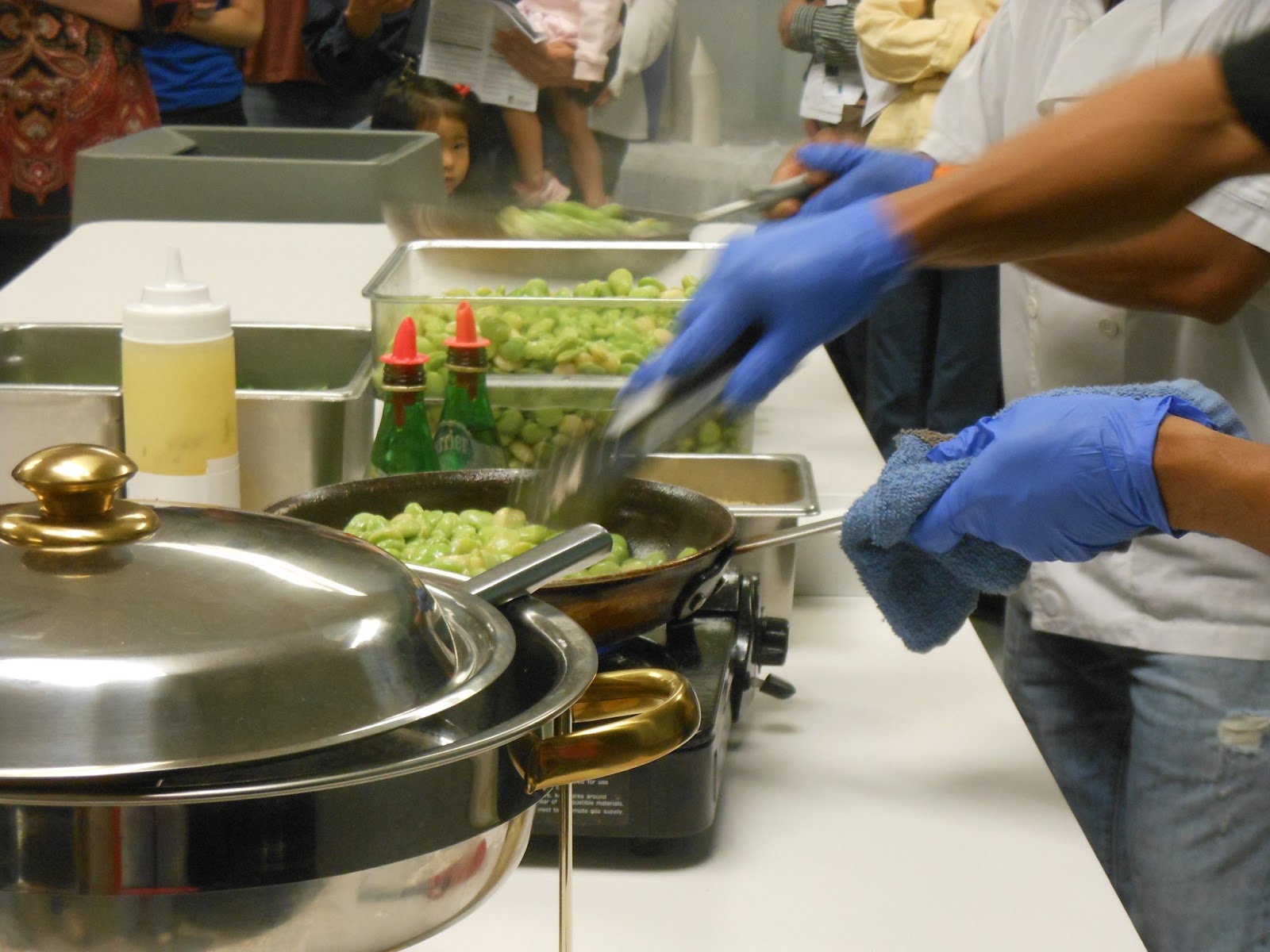
One of our favorite restaurants is Mayan Cafe in Louisville, and my favorite item on the menu is Tok-Sel Lima Beans. I don't know what Tok-Sel means in Mayan but the beans are great. And apparently everybody else in town shares my opinion, because when the public library put on its annual How-To festival and invited Bruce Ucan, the Mayan's chef, to give a demo, they refused to let him fix what he suggested -- it was lima beans, non-negotiable.
Good news for home cooks: you can start with frozen limas if you don't have fresh (the chef does it all the time). Defrost them but don't precook.
Put them in a hot frying pan with your favorite oil and sear them, stirring all the time, for several minutes till the beans are brown and roasted. Add a lot of chopped parsley and chopped green onions and saute for another minute or so.
Then comes the secret ingredient: pumpkin seeds. You roast the seeds in a 350 degree oven, then grind them in the Cuisinart. When the beans in the frying pan are almost ready to serve, toss in the pumpkin seeds. A spritz of lemon juice, and you're done.
Make a lot (the chef suggests a half pound for four servings). I'd be happy to just have a triple serving and call it dinner.
The chef says the actual Mayans don't use lima beans; they prefer a big white bean such as Great Northern. The traditional preparation is to sear the beans with hot rocks, which are then piled on top of the beans to keep them hot while awaiting customers for street food. So if you like another kind of bean, you have his blessing to substitute it.
Good news for home cooks: you can start with frozen limas if you don't have fresh (the chef does it all the time). Defrost them but don't precook.
Put them in a hot frying pan with your favorite oil and sear them, stirring all the time, for several minutes till the beans are brown and roasted. Add a lot of chopped parsley and chopped green onions and saute for another minute or so.
Make a lot (the chef suggests a half pound for four servings). I'd be happy to just have a triple serving and call it dinner.
The chef says the actual Mayans don't use lima beans; they prefer a big white bean such as Great Northern. The traditional preparation is to sear the beans with hot rocks, which are then piled on top of the beans to keep them hot while awaiting customers for street food. So if you like another kind of bean, you have his blessing to substitute it.
Friday, September 21, 2012
Dinner from the past
As frequently happens in the afternoon, I asked my husband if he had any brilliant ideas for dinner. Was there anything in particular that he would love?
And to my surprise, he suggested -- eatmore!
Eatmore was one of his mother's regular dinners, consisting of ground beef, tomatoes, noodles, and other ingredients that hadn't lasted quite so strongly in memory. We'd discussed this dish in the past, and I had recalled one of my mother's regular dinners, known as "goulash" but bearing no resemblance to any goulash you would find in Hungary or any cookbook. Indeed, our "goulash" was very similar to his eatmore -- ground beef, tomatoes, elbow macaroni.
Both eatmore and "goulash" were swimming in a lot of tomato broth. My mother-in-law would often siphon off the broth and serve it as a separate soup course, thus enabling the main course to be served on a plate. By contrast, my mother's goulash was served in bowls (I think I'm remembering right) and you slurped up the broth with a spoon.
I used to hate goulash night. Not that it tasted bad, but I didn't like that juice. It made the whole entree seem insipid and washed out. On goulash night I would volunteer to serve out the plates, giving my own plate as little of the juice as possible.
My husband, on the other hand, thought the broth was wonderful.
When he expressed the surprising desire for eatmore it was even more surprising that I said why not -- the first time in 42 years of marriage that I had done so. I asked whether eatmore ever included bell peppers (we owned two big red peppers that were perilously near the end of their shelf life) and he said he thought it did. Since this was a nostalgia trip, I asked whether it included onions (he thought yes) and asked him to find the closest possible noodle from our pasta shelf.
I found a pack of already cooked ground beef in the freezer, which made life much easier. Cut up the peppers and an onion, added a fresh tomato that was also in dire need of being eaten plus a can of diced tomatoes. Set it all to cooking.
Next question: what seasonings were used in eatmore? He searched his memory and thought none. Which is exactly what seasonings were used in "goulash." But that sounded inadequate, so I took the liberty of adding some garlic and some marsala wine to wash out the tomato can.
I'm sure both our mothers would have cooked the pasta in a separate pot, but I almost always cook pasta in with its sauce. Fewer pans to wash, and the pasta absorbs good flavor instead of just serving as a neutral base.
Old habits die hard. I served up my husband's bowl with lots of juice, but kept mine as dry as possible. He loved his. I thought mine was insipid and washed out. Maybe it was the peppers -- plenty of them, and so sweet that they dominated the dish. (Probably my mother-in-law would have used green peppers; maybe they would have tasted better.) Maybe it was the memory of "goulash" hanging over my head.
But at least one of us was really happy!
Sunday, June 17, 2012
Getting a makeover???
I don't read much in the USA Weekend Sunday supplement, not having an interest in the stars of vampire movies who anchor the celebrity gossip page, but I do eyeball the recipes. I have noticed approvingly that the magazine does include a lot of medical and fitness information, and its recipes seem to be healthier than most.
So I was intrigued to read that this week's dish was billed as "a summer side gets a makeover."
It's a three-bean salad, made over by using edamame and fresh green beans instead of canned. And, according to the write-up, "a sweet-tart dressing that gets its primary sweetness from apricot all-fruit preserves instead of the refined sugar in the usual recipe." (Subtext: fruit good, refined sugar bad!)
That sounds good, until you read the recipe. Sure, there's a quarter-cup of apricot preserves (160 calories) -- plus a tablespoon of bad old refined sugar (45 calories more).
Hmmm, where to start.
First, if it's good to get your sweetness from fruit, why add the sugar?
Second, if fruit good refined sugar bad, how come the fruit is providing almost four times the calories of the sugar? Sounds like neither one is very good.
Third, why do we want almost 14 teaspoons of sugar in our vegetables?
I checked out the traditional recipes for three-bean salad and most of them have even more sugar than this version, so I guess this is a healthy makeover as far as it goes. But it doesn't go very far. As long as we're encouraging people to rethink grandma's recipes, canned vegetables with lots of sugar, why not encourage them to rethink with one teaspoon of sugar, or none?
So I was intrigued to read that this week's dish was billed as "a summer side gets a makeover."
![]() |
| photo -- USA WEEKEND |
It's a three-bean salad, made over by using edamame and fresh green beans instead of canned. And, according to the write-up, "a sweet-tart dressing that gets its primary sweetness from apricot all-fruit preserves instead of the refined sugar in the usual recipe." (Subtext: fruit good, refined sugar bad!)
That sounds good, until you read the recipe. Sure, there's a quarter-cup of apricot preserves (160 calories) -- plus a tablespoon of bad old refined sugar (45 calories more).
Hmmm, where to start.
First, if it's good to get your sweetness from fruit, why add the sugar?
Second, if fruit good refined sugar bad, how come the fruit is providing almost four times the calories of the sugar? Sounds like neither one is very good.
Third, why do we want almost 14 teaspoons of sugar in our vegetables?
I checked out the traditional recipes for three-bean salad and most of them have even more sugar than this version, so I guess this is a healthy makeover as far as it goes. But it doesn't go very far. As long as we're encouraging people to rethink grandma's recipes, canned vegetables with lots of sugar, why not encourage them to rethink with one teaspoon of sugar, or none?
Sunday, April 22, 2012
No-work chicken-in-the-pot
A houseful of people came over for dinner the other night and I didn't want to do any serious cooking. So I decided to make my one-dish no-work chicken -- nice enough for company and fairly easy to make. I always like dinner menus where you can get your preparation done early in the afternoon, then retreat to sew, play Killer Sudoku or read a book while the food cooks itself. And occasionally I like recipes where you can open some cans instead of making everything from scratch, thus getting me out of the kitchen faster.
This dish can be done on the top of the stove in a dutch oven or in a crockpot (that way takes a bit longer and probably isn't quite as delicious, but it's pretty darn good).
I had seven people for dinner, three of whom are BIG MEN, and I started with just over two pounds of skinless, boneless chicken breasts. I cut each one into three chunks so those of us who are not BIG MEN could take smaller servings. I browned them in a bit of olive oil over high heat and removed them to a plate.
I cut four onions in half and then sliced them into long skinny threads, put them into the pot that the chicken had been in, and cooked them for a while on medium heat till the onions got translucent. Had I felt ambitious I might have kept on till they started to caramelize and turn brown, but I didn't want to spend the whole day in the kitchen.
While the onions cooked I chopped up some garlic and threw it in with the onions. How much garlic to use in any dish is always a very personal decision -- use as much as you and your guests can tolerate. But remember that cooked garlic isn't anywhere near as strong as raw, so be brave.
Our rosemary plant has been looking healthy and starting its spring growth spurt, so I cut a foot-long sprig and buried it underneath the onions. Dumped the chicken back into the pot and added a can of cream of chicken soup, about a half can of white wine, and a can of artichoke hearts, cut into quarters. Ground some black pepper over the top. After everything had warmed up and started to cook enthusiastically I turned the heat down so the liquid was barely moving, with languid bubbles every now and then. And went away for three hours.
While I did other things the ingredients cooked together and made their own gravy, which we ate over mashed potatoes. If you didn't want to do potatoes, you could serve a sturdy bread to sop up the gravy.
If you use a crockpot, you wouldn't bother with browning the chicken or the onions -- just dump everything into the pot and go off to work. The dish might be a bit paler but it will taste just fine. You might even put some quartered potatoes into the pot and let them cook with the chicken. (I guess you could do that in the dutch oven, too, and save yourself the trouble of making mashed potatoes.)
If you aren't having lots of BIG MEN over for dinner, use just one package of chicken breasts, about one pound. But still use one can each of soup and artichokes. You'll end up with proportionally more vegetables and gravy but it won't change the taste, consistency or effect.
Monday, January 24, 2011
Some nice new recipes for you
I wrote last week about the deserted research station we visited in Antarctica and what I found in the kitchen. A couple of days later we visited another such place, except this one has been kept heated and occupied as a museum/gift shop. I think some of the stuff in this hut is not authentic, but brought in as representative of the supplies and equipment that would have been found in the 1950s.
That would explain the relatively good condition of the cookbook on the stove, which I stupidly neglected to photograph the cover of. Maybe it's a latter-day compilation of recipes from the time.
But in any case, we're all looking for new ideas to perk up our boring repertoire of entrees, so maybe these will pique your culinary imagination. I know the reconstituted turnips and peas sparked some thoughts for me. Bon appetit!
Rats -- I should have turned the page to get the end of the recipe. Guess we'll just have to improvise from here.
Subscribe to:
Posts (Atom)